Mechanical design & tooling

Good assembly
starts with a
better fixture.

Practical mechanisms. Thoughtful part location. Assembly fixture concepts built around the way you work.

Explore fixture concepts

Independent engineering. Purposeful design.

ASSEMBLY FIXTURE STUDYSD / 001
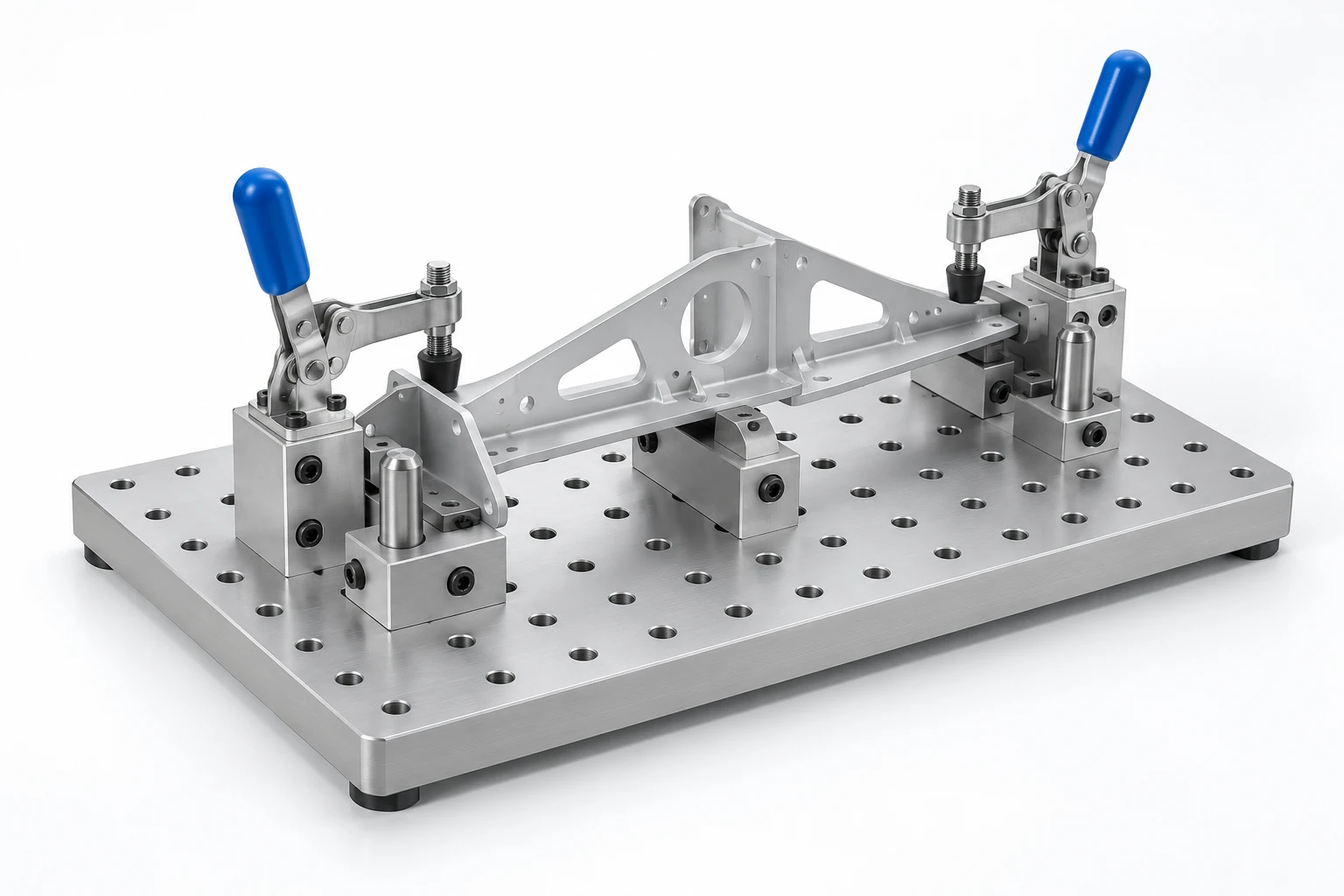
Illustrative concept of a machined modular baseplate supporting a sheet-metal bracket with locating blocks and blue-handled clamps.
01 Modular assembly platformConcept illustration
01

Locate precisely.

Give every part a defined reference.

02

Work comfortably.

Keep tools and fasteners within reach.

03

Set up consistently.

Make the next assembly familiar.

01 / Fixture concepts

A place for every part.
A purpose for every detail.

Three starting points for more repeatable assembly. Each concept can be developed around a specific part, process, and operator.

01FLEXIBLE SETUP

Modular assembly
platform

One base. A flexible starting point for a family of assemblies.

The idea

A common baseplate with repositionable supports, dedicated locating features, and interchangeable clamps.

Where it fits

Bench assembly, prototype hardware, and small production runs with changing part geometry.

Explore the mechanism

Use the hole pattern to mount modules, then locate the part against dedicated pins or stops. Add removable nests for different assemblies while keeping a familiar working surface.

Design question: which features must stay fixed between setups?

02PART ALIGNMENT

Sheet-metal
alignment fixture

Hold the relationship between parts while the assembly comes together.

The idea

A dedicated nest with datum stops and supported clamping points to position formed parts before fastening.

Where it fits

Enclosures, brackets, frames, and assemblies where flange alignment and joint access matter.

Explore the mechanism

Support thin sections near the clamp contacts and leave working clearance around joints. Select a primary reference, then use secondary stops to locate the assembly without forcing every surface into contact.

Design question: how much formed-part variation must the nest accommodate?

03BETTER ACCESS

Rotating assembly
cradle

Bring the working face to the operator. Keep the assembly supported.

The idea

A supported cradle with a mechanical indexing and locking mechanism for repeatable working positions.

Where it fits

Tubular structures, long enclosures, and assemblies that need fastening or inspection on several sides.

Explore the mechanism

Mount the assembly between supports and rotate it to defined working angles. Use a positive locking feature to hold each position and removable adapters to suit the part interfaces.

Design question: how do the assembly weight and center of gravity affect support and handling?

Concepts in development. Final geometry and performance would be established through detailed design and physical validation.

02 / Our approach

Start with the part.
Design for the process.

A fixture should make the job clearer. The design begins with what needs to be held, how it will be assembled, and what the operator needs to reach.

Get to know Surgent
  1. 01

    Define the references.

    Identify the critical interfaces, part variation, and features that establish the assembly position.

  2. 02

    Keep the mechanism practical.

    Choose supports and clamps around access, stiffness, part protection, and straightforward loading.

  3. 03

    Build. Check. Refine.

    Evaluate fit, loading sequence, and repeatability with real parts. Use the findings to improve the design.

03 / Surgent Dynamics

Thoughtful tooling.
Repeatable assembly.

Surgent Dynamics is a mechanical design venture focused on practical tooling and mechanisms.

Rooted in aerospace manufacturing experience, our interest is in the details that make hardware easier to build: part location, accessible joints, sensible clamping, and a setup that makes sense at the bench.

Based in Southern California